How I wanted the first lines of my story to be: serious, poetic, something to look back on and slap your forehead at because of the hidden foreshadowing
The actual first lines of my story:
10/10 would rather read a story with the second beginning.
title is a literal description of the story (”5 times x did y”, “first kiss”, etc)
perfect formatting, title is evocative of the story’s main themes
song lyrics
3 feet long all lowercase (overlaps w/ song lyrics)
one word. only one.
title seemingly has nothing to do w/ the content of the story until it gets dropped during a high-tension dramatic scene 70k words in, making you feel like the world meant for you to be born in time to read it
We read these aloud while slightly drunk in Ireland last summer, and it’s one of my favorite memories. I still can’t pick my favorite, as at lease five of these made me laugh so hard I cried.
this isn’t my writing, but i just- i gotta- this- too good.
i wish for my writing to ascend to this level. please.
Can I just… talk for a moment… about how much I love how, if you know them well, words don’t have synonyms?
English, for example, is a fantastic disaster. It has so many words for things that are basically the same, and I find there’s few joys in writing like finding the right word for a sentence. Hunting down that peculiar word with particular meaning that fits in seamlessly in a structure, so the story flows on by without any bumps or leaks.
Like how a shout is typically about volume, while a yell carries an angry edge and a holler carries a mocking one. A scream has shrillness, a roar has ferocity, and a screech has outrage.
This is not to say that a yell cannot be happy or a holler cannot be complimentary, or that they cannot share these traits, but they are different words with different connotations. I love choosing the right one for a sentence, not only for its meanings but for how it sounds when read aloud. (Do I want sounds that slide together, peaceful and seamless, or something that jolts the reader with its contrast? Snap!)
I love how many words for human habitats there are. I love how cottage sounds quaint and cabin sounds rustic. I love steadiness of house, the elegance of residence, the stateliness of manor, and tired stubbornness of shack. I love how a dwelling is different to a den.
And I love how none of them can really touch the possessive warmness of all the connotations of home.
Words are great.
I did not expect to cry by the end of this, but I did.
Which proves the point, no?
“The difference between the right word and the almost right word is like the difference between a lightning bug and the lightning.” – Mark Twain (and one of my favorites, since I happen to agree with everything the OP said!)
Have a chart I developed for visualizing the disposition of your character! This is partly inspired by a chart I saw of Aristotle’s Golden Mean, which is a system he had for developing good character, but of course, this is more about gauging a character’s traits than bringing them into any kind of balance.
For a printable PDF version of the chart please follow this link.
@probablybadrpgideas Replace the alignment chart with this in all games. Be strict about players sticking to it.
Nothing weird to say this time, just throwing in my 2 cents that this might be more useful if the scale was 1-20 instead of 1-25. Nothing major, just lets you roll for them if you want to.
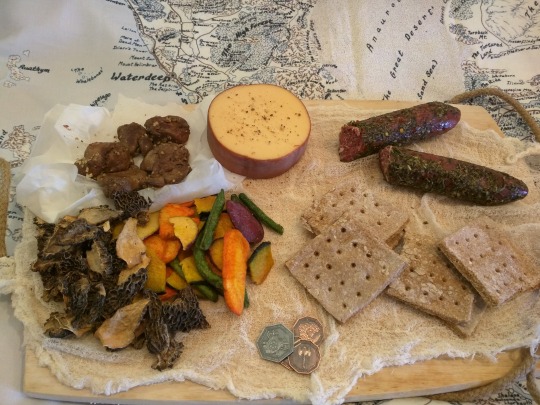
[[ Source. Original creator: wats6831. Additional information and images linked under each one. ]]
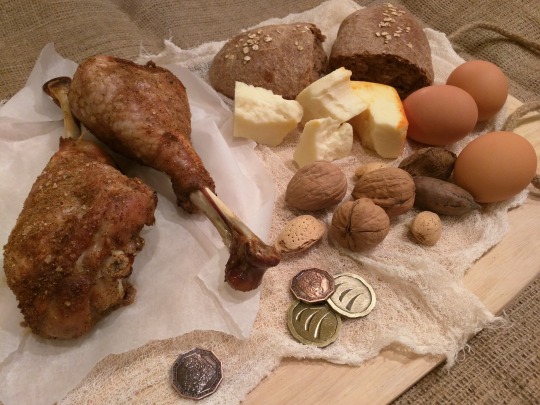
Universal:
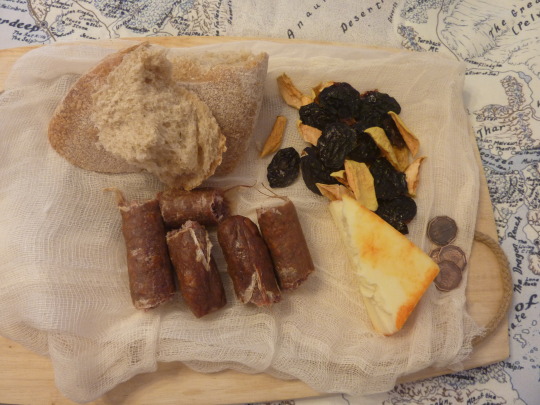
Homemade artisan herb bread, home grown and dried apples and prunes, uncured beef sausage, munster cheese. Made a small bag from cheesecloth and tied it closed.
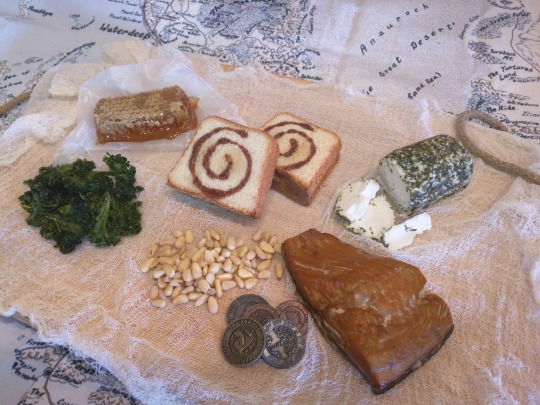
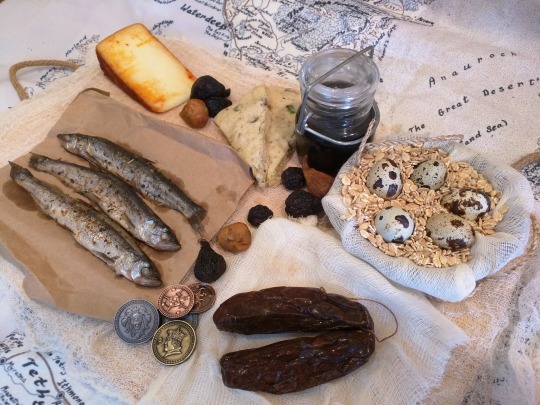
Top left to right: Evereskan Honey Comb, Elven Travel Bread (Amaretto Liquer Cake with custom swirls), Lurien Spring Cheese (goat cheese with garlic, salt, spices and shallots), Delimbyr Vale Smoked Silverfin (Salmon), Honey Spiced Lichen (Kale Chips), and Silverwood Pine Nuts.
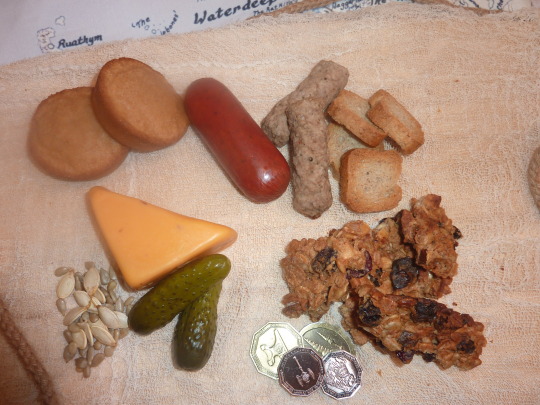
From upper left: “Honeytack” Hard tack honey cakes, beef sausage, pork sausage mini links, mini whole wheat toast, cranberry cheddar cheese mini wedge, mini pickles, pumpkin and sunflower seeds, lower right is my homemade “travel cake” muesli with raisins, golden prunes, honey, eggs and cream.
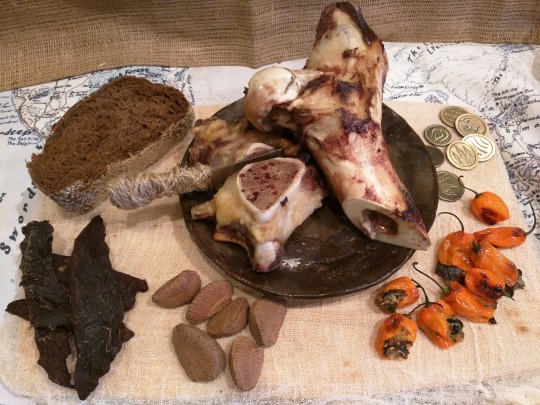
Orcs aren’t known for their great cuisine. Orcs prefer foods that are readily available (whatever can be had by raiding), and portable with little preparation, though they have a few racial delicacies. Toughs strips of lean meat, bones scavenged from recent kills, and dark coarse bread make up the bulk of common orc rations.Fire roasted rothe femur (marrow is a rare treat) [beef femur], Strips of dried meat (of unknown origin) [homemade goose jerky], foraged nuts, only edible by orcs….nut cracker tusks [brazil nuts], coarse black bread, made with whatever grains can be pillaged [black sesame bread], Pungent peppers [Habanero peppers stuffed with smoked fish and olives].
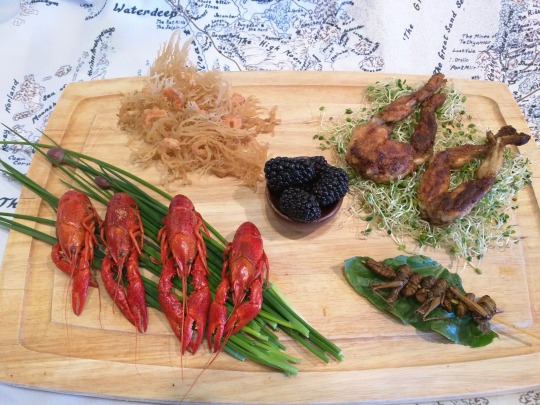
Lizardfolk are known to be omnivores, forage for a surprising variety of foods found within the confines of their marshy environs, in this case the Lizard Marsh near Daggerford. Fresh caught boiled Delimbyr Crayfish on wild chives, coastal carrageen moss entrapping estuary brine shrimp (irish moss, dried brine shrimp), Brackish-Berries (blackberries), Blackened Dart-Frog legs (frog legs) on spring sprouts (clover sprouts), roasted bog bugs on a stick!
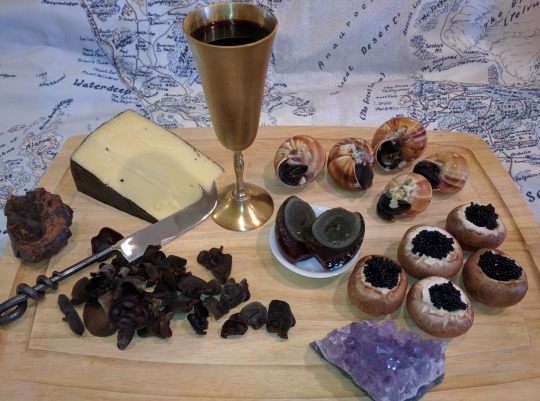
From top left: Menzoberranzan black truffle rothe cheese (Black Knight Tilsit), Donigarten Moss Snails (Escargot in shallot butter sauce), Blind cave fish caviar in mushroom caps (Lumpfish caviar), faerzress infused duck egg imported from the surface Realms (Century egg), Black velvet ear fungus (Auricularia Black Fungus Mushroom).
Sometimes i think about the idea of Common as a language in fantasy settings.
On the one hand, it’s a nice convenient narrative device that doesn’t necessarily need to be explored, but if you do take a moment to think about where it came from or what it might look like, you find that there’s really only 2 possible origins.
In settings where humans speak common and only Common, while every other race has its own language and also speaks Common, the implication is rather clear: at some point in the setting’s history, humans did the imperialism thing, and while their empire has crumbled, the only reason everyone speaks Human is that way back when, they had to, and since everyone speaks it, the humans rebranded their language as Common and painted themselves as the default race in a not-so-subtle parallel of real-world whiteness.
In settings where Human and Common are separate languages, though (and I haven’t seen nearly as many of these as I’d like), Common would have developed communally between at least three or four races who needed to communicate all together. With only two races trying to communicate, no one would need to learn more than one new language, but if, say, a marketplace became a trading hub for humans, dwarves, orcs, and elves, then either any given trader would need to learn three new languages to be sure that they could talk to every potential customer, OR a pidgin could spring up around that marketplace that eventually spreads as the traders travel the world.
Drop your concept of Common meaning “english, but in middle earth” for a moment and imagine a language where everyone uses human words for produce, farming, and carpentry; dwarven words for gemstones, masonry, and construction; elven words for textiles, magic, and music; and orcish words for smithing weaponry/armor, and livestock. Imagine that it’s all tied together with a mishmash of grammatical structures where some words conjugate and others don’t, some adjectives go before the noun and some go after, and plurals and tenses vary wildly based on what you’re talking about.
Now try to tell me that’s not infinitely more interesting.



 sparksoffandommagic