One thing I never really understood was Sleipnir (meaning “slippery one” fyi) in depictions of Norse mythology. Sleipnir is an eight-legged horse, the steed of Odin and the son of Loki, and he is commonly depicted like this:
(image not mine)
But why would you depict an eight-legged horse like this? Horses gallop the same way most other mammals run, with all feet leaving the ground at one point, so having extra feet here doesn’t seem like it could make the horse any faster. I’m also not sure it would give it any more stable footing, since it doesn’t have a wider base.
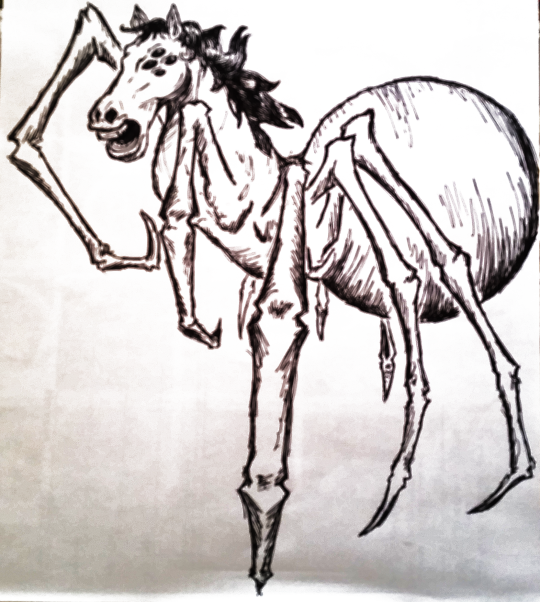
If you want a stable eight-legged form that can reach great speeds for its size, wouldn’t you want to start with what nature has already provided? Wouldn’t you want something more like… this?
(my drawing)
“But wait!” you might say, “Sleipnir was conceived when Loki, in horse-form, seduced another horse! That’s why it looks all horsey, just with extra bits!”
Well, that’s a good point, but consider that Loki as a deity was originally based off the spider, and his name even derives from the old Swedish word for spider (source). Therefore, it’s not too hard to believe Sleipnir inherited his horse half from his mother and the more spidery half from his father. In conclusion:
Spider-Horse, Spider-Horse, He does spider-things of course! Weaves a web, Makes you gawk, Riding round ‘til Ragnarok! Look out! Here comes the Spider-Horse.
I am all for creative interpretations of Sleipnir. And spiders, obviously. This is epic.
But just so you know, that journal is from the 60′s, and the current scholarly consensus no longer considers the spider etymology to be likely. We still aren’t sure where the name comes from, and probably won’t ever be, but I’ve seen quite a few more recent academics lean toward Old Norse luka, meaning “close”, “shut”, or “end.” (See Simek’s Dictionary of Northern Mythology.)
^^^^ my research found much the same. (which is sad, i like spiders)
As far as Sleipnir having eight legs, it’s probably a reference to Icelandic horses. Icelandic horses are one of the few horse breeds with five gaits. They can do a walk, trot and canter/gallop, like most horses. But they have also evolved to have a tolt,
[ gif of a man riding a brown Icelandic horse doing a tolt. The back legs of the horse move rather stiffly back and forth, while the front legs are lifted up almost to the horse’s chest. While the horse bounces slightly, the man riding the horse could probably hold a glass of water without spilling. ]
which is fast, smooth and noted for its explosive speed and ability to cover long distances.
The second unique gait is called flugskeið, or flying pace.
[ a light brown Icelandic horse demonstrating the flugskeið. With the exception of the wind in the horses’ mane, the upper part of the horse and the rider seem to almost be still, with the background simply zipping by them. The horse’s legs, however, move fast enough to blur. Unlike with a full gallop, the horse does not fully extend its legs away from its body. This is particularly obvious in the front legs of the horse, which lift up to the chest of the horse and land under its chin the same way as in the tolt]
It is both smooth and fast, some horses being able to reach speeds of 30 mph. Not all Icelandic horses can do a flugskeið, but you’ll notice that when done properly the legs move in unison and so fast they can blur, giving the illusion of the horse having eight legs.
Anyways, here is a video to further emphasize how cool the flugskeið is;
I’d never heard this theory! That’s so neat.
The one I’ve read attributed the eight legs thing to a metaphor of a coffin + 4 pallbearers.
This is FASCINATING, and I adore Sleipnir! 😍 @tinaferraldo
You’ve brought my horse geek out now. You have been warned!
The thing is, until the late 1800s we didn’t know how horses moved.
In old paintings you typically see horses with their legs stretched wide as they thought that gave the appearance of great speed.
But it really just looks like Timmy’s big brother was being an evil bastard and bent the legs of his tin horses out .
It’s completely unnatural looking, but horses moved too fast for us to be able to see how they moved, until Edward MAuybridge captured their motion in a series of consecutive photographs in 1878.
And for the first time we could see that all four legs did leave the ground. (and are never stretched uncomfortably wide!).
He also created the first motion picture as the individual photographs could be put together as a series of film frames (below).
So, all this is to say that back when Sleipnir was being dreamed up, they didn’t understand how animals moved and probably thought more legs = faster, and to a degree they were right, things on four legs run faster than bipeds so they continued that principle to its logical, if incorrect, conclusion.
THIS IS THE BEST HORSE MOVEMENT DISCOURSE EVER
or we can consider that norse epics were, above all else, poetry, and consider that the image of an eight-legged horse brings to mind a horse that moves like a spider – with that fast darting scuttle that so many people find terrifying. an alien horse. a divine horse. a monster.
(personally i find the spider run adorable, like when a cat gets startled and does the skitter. but i recognize this is an unusual reaction.)
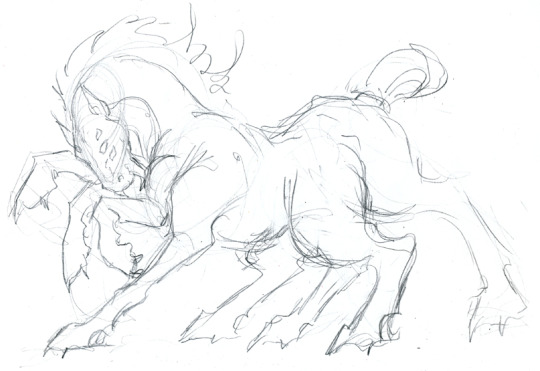
So, inspired by the whole concept of a spider-horse I very loosely sketched this:
…To which my brother @foxofwar simply pointed out, that being a spider-horse, it’s a sporse.
Slightly off topic, but it isn’t unique to Norse mythology to give a magical horse unusual number of legs tho. In Hungarian folklore special horses (usually fond of eating cinders, capable of flying or running faster than the win or even faster than thoughts, usually liked to sass the hero of the tale) had 5, 6 or 7 legs.
Obviously those numbers were chosen because they held cultural significance (our dragons/giants had odd number of heads too), but it probably sounded like common sense that more legs=faster horse.
I have nothing to add but damn is this thread epic.
There’s a Peruvian horse breed called the Paso that has a fifth gait as well – kind of a smooth, toe-skimming shuffle between the trot and the canter. It’s smooth as butter.
They’re lovely, but they MUST be kept in a pot, or a raised bed, or on a good-quality leash with a chest harness, because mint and its cousins spread like… IDEK, like a rash. Like dandelions. They’re tough, hardy and highly motivated. Even a tiny root fragment will suddenly turn into a Mint Tree if you don’t tear it up. I swear I’ve seen new plants popping up from BURIED SCRAPS OF LEAF. Once they’re in the ground they establish a beachhead and spawn secretly, possibly through osmosis. I cannot advise you to stick a mint plant in the ground unless you are a bold and unconventional disciplinarian.
The joke is that after running around after the mint like a spaniel chasing a whack-a-mole for a year, Dr Glass then planted a plant that would do the same thing.
Great plants, hard to kill, keep them in a pot (ESPECIALLY where invasive)
I would really recommend against planting mint in raised beds, and also, if in a pot, DO NOT PUT THE POT ON SOIL. The pot needs to be on rock or concrete. Otherwise the roots will head straight for freedom through the drainage holes, and you will Never Be Free.
of course, on the other hand, if you’re at all inclined to pettiness expressed via herbology, mint makes a GREAT vehicle for plant-based vengeance.
i have absolutely thrown mint roots into the perfectly manicured lawns of people i hate.
An ever growing mint plant appearing in my lawn would seem like the opposite of a problem to me?
They’re invasive, which means if they’re anywhere in your garden or manicured areas they could ruin the other plants, I think? But yeah I’d love to have a damn mint plant in my yard sounds ideal.
Has anyone ever thought of just having a lawn of mint instead of grass? Like how you have moss lawns?
… I am not judging!! but I don’t think the people in the notes who are like “oh a mint lawn would be lovely!” have met mint!
You know what would be a lovely herbal lawn? Chamomile. Because it’s a damn compact, densely-growing, hardy, winter-green perennial that’s springy underfoot, smells nice when you walk on it, and has some basic manners. Lawn chamomile is plushy and soft and produces tiny pretty daisy-looking flowers. It naturally stays at pretty much the height you would want grass to be, and then you can cut it and it goes “fair enough.”
Mint is not any of those things. Mint is leggy, patchy, muddy and rampageous. It grows randomly and fitfully. It bullies other plants. It sends runners into the neighbor’s houses and across the street and it barks at the postman. Your mint lawn would look like a poorly tended graveyard AND THEN IN THE WINTER IT WOULD DIE, DRAMATICALLY, and ROT THERE. It would outcompete native plants and eat your vegetable garden alive. It is so wet and stalky that it would be dreadful to trim, and when you trimmed it, it would scab over and sulk. It would refuse to grow where it was put (the lawn) and would instead show up in places you don’t want it (the patio, the sidewalk, your intrusive thoughts.) IT IS AN INVASIVE PLANT, WHY WOULD YOU DO THIS TO YOUR FAMILY
It’s like asking why people don’t make lawns out of cabbages, or hyenas, or the cold virus. BECAUSE THEN IT WOULDN’T BE A LAWN OR A GARDEN
Things are heating up in the herb fandom.
Reblogging because this conversation deserves to be shared with tumblr; Chris Pike would totally give mint as a gift to someone he hated as revenge.
I am really curious as to where @elodieunderglass is from. Because, well, the thing about invasive species is that they are only invasive in some areas.
And I can attest to being able to *kill* mint plants where I live. Ones out in the yard and everything, and they certainly aren’t on my areas list.
I’m from New England, USA. I live in Old England, Europe.
The thing with mint is that it’s not necessarily a lot of Invasive Species watch lists, it’s *an* invasive – an unscientific and loose term for things whose natural history and reproductive habits mean they can quickly outcompete native organisms. It isn’t An Invasive Plant ™ in its native soils, which are around Europe and the MENA region. Instead, it behaves invasively, like bindweed.
Mint’s brilliant, admirable secret is its long runners, or horizontal water-seeking roots. A tiny sprig will produce extremely long underground runners that can be many feet long. If a runner encounters a water source, it can suck it up and feed the host plant (so a mint plant growing in the middle of barren concrete may be slurping up water from a garden across the street, or a leaking pipe under the sidewalk, or possibly Neptune.) and each runner can also pop up a stalk in a new location, creating a new plant. A section of runner or other root is perfectly capable of making a new plant, so a fragment of buried root in a neighbor’s garden could result in a mint popping up in your patio. Mint also spreads by seed, so it disperses very efficiently.
Why is this a problem? Eh, it’s not really. It’s simply doing what’s in its nature. I always advocate for that. But it will outcompete your garden in most conditions – I.e if your other herbs want water, mint will steal it out from under them. It’s a water hog, as simple as that. In dry conditions or climates it will politely limit itself to places where it is given water, but if you start watering another part of the garden – maybe you want to cultivate a rose, or an olive tree – the mint will magically show up there, banging its water dish and looking expectant. And it will say “I had a secret runner that went here, Just In Case.” And you’ll say “fair enough, you mad bastard.”
But you’re right, my terminology was unclear. It’s a confusing way to use it and I won’t do it again
This Mint Discourse is the karmic price I must pay, since two years ago my husband chucked a mint plant into the field of a farmer he didn’t like, and I… Reader, I let him do it
Thank you all for warning me not to plant “a little mint” around the side of the house because it would be “nice to have around”.
Thank you all again for letting me know that this is a credible form of botanical terrorism.
CHOICE EXCERPTS:
they establish a beachhead and spawn secretly, possibly through osmosis
like a spaniel chasing a whack-a-mole for a year
pettiness expressed via herbology,
plant-based vengeance
i have absolutely thrown mint roots into the perfectly manicured lawns of people i hate.
[Chamomile] has some basic manners
Mint is… rampageous. It bullies other plants…. It barks at the postman
like a poorly tended graveyard
It’s like asking why people don’t make lawns out of cabbages, or hyenas, or the cold virus
so a mint plant growing in the middle of barren concrete may be slurping up water from a garden across the street, or a leaking pipe under the sidewalk, or possibly Neptune.
In dry conditions or climates it will politely limit itself to places where it is given water, but if you start watering another part of the garden – maybe you want to cultivate a rose, or an olive tree – the mint will magically show up there,
banging its water dish and looking expectant
“fair enough, you mad bastard.”
This Mint Discourse is the karmic price I must pay, since two years ago my husband chucked a mint plant into the field of a farmer he didn’t like, and I… Reader, I let him do it
credible form of botanical terrorism.
@memprime @elodieunderglass @semianonymity @nehirose @voidbat @hello-hayati @eminenceofiyanola @elodieunderglass @dirtycorzaharkness @naamahdarling I want to thank each and every one of you. The talent and the bright minds behind this post, incredible. We wouldn’t be standing here today without you. This was a group effort, a team play. Y’all came together and gave it your A game and that really shows through in the final product. Good job team, you really did it.






 sparksoffandommagic