Roses are red, that much is true, but violets are purple, not fucking blue.
I have been waiting for this post all my life.
They are indeed purple, But one thing you’ve missed: The concept of “purple” Didn’t always exist.
Some cultures lack names For a color, you see. Hence good old Homer And his “wine-dark sea.”
A usage so quaint, A phrasing so old, For verses of romance Is sheer fucking gold.
So roses are red. Violets once were called blue. I’m hugely pedantic But what else is new?
My friend you’re not wrong
About Homer’s wine-ey sea!
Colours are a matter
Of cultural contingency;
Words are in flux
And meanings they drift
But the word purple
You’ve given short shrift.
The concept of purple,
My friends, is old
And refers to a pigment
once precious as gold.
By crushing up molluscs
From the wine-dark sea
You make a dye:
Imperial decree
Meant that in Rome,
to wear purpura
was a privilege reserved
For only the emperor!
The word ‘purple’,
for clothes so fancy,
Entered English
By the ninth century
.
Why then are voilets
Not purple in song?
The dye from this mollusc,
known for so long
Is almost magenta;
More red than blue.
The concept of purple
is old, and yet new.
The dye is red,
So this might be true:
Roses are purple
And violets are blue
.
While this song makes me merry, Tyrian purple dyes many a hue From magenta to berry And a true purple too.
But fun as it is to watch this poetic race The answer is staring you right in the face: Roses are red and violets are blue Because nothing fucking rhymes with purple.
Hirple – To limp or walk awkwardly
Cirple – An old Scots word for the hindquarters of a horse
tumblr meme culture is really just a form of neo dadaism
I’d like to clarify:
dada was a largely european art movement that took place after wwi. this time and place is not a coincidence. let me explain.
dada art made no sense. the artists who made dada lived in a world in which nothing made sense – in which conventional logic led to the senselessness of a world war. so, making art that made no sense, making – well, you can’t really call it art, so making ANTI-art that rejected the conventions that brought about that atrocity in the first place – it made total sense. (if that makes any sense.)
so the artists did weird things. new things! putting things that were already made together and calling it sculpture, cutting up bits of pictures and putting them together and calling that something to frame – this site has some nice examples.
but from my perspective – there’s serious intellectual continuity between the absurdity of attaching a bunch of tacks to the bottom of an iron, rendering it useless, and say…. bath bomb posts. Put a fucking macbook in a bath. it’s useless now. Nobody fucking cares anymore. you want something funny? you want a punchline? gun. that’s your punchline. Take it. I am laughing
in a way it could be a method of venting some of the frustration and hopelessness and dissatisfaction that tumblr’s userbase (largely, disenfranchised millennials) feels in the modern day. I can’t really speak for anyone else, but… at least from a US perspective, there’s plenty to be disillusioned about. growing up in a constant state of questionably justified war, income inequality, an economic recession caused by the actions of a handful of wealthy fucks who didn’t even get properly punished, growing awareness of police brutality, being called lazy and self-absorbed by the generations that gave us these problems in the first place… I can’t help but think that these factors (and more) could produce a similar mindset to the one that precipitated the first dada movement.
so of COURSE we make nonsense jokes. it’s a coping mechanism for a world which doesn’t make any sense.
related: this isn’t by tumblr but I have to plug UCLA’s atrocity of a virtual gallery once more. it really needs to be experienced, but… it’s definitely also millennial neo dada. from the presentation (like an unplayable video game) to the content (THE DOGS HAVE ARRIVED), it is exactly what I am talking about. it is a fucking shitpost. and it’s high art, too! I love this
tl;dr: my generation is fed up with this bullshit, and the best way that we can express that is by shitposting. alternatively, dada was an early precursor to modern shitposting and we should all thank duchamp for signing a fucking urinal
a dear friend has given a perfect update to some of my phrasing, courtesy of their word replace extension:
you see this? this is exactly what I’m fucking talking about. the thing that I’m talking about is:
I’d also say that while Dadaism was obsessed with the technological aspects of Modernity, of newspapers, of industrial mechanics and factory made clocks, neo-dadaism (of which shitposting but also the increasingly broad reach of the New Aesthetic and net aesthetics) is obsessed with the technological aspects of our time, or at the beginning of our time.
As just a comparison, the Clock in Absurdist and Dadaist art is both a symbol of the uplifting beginning of industrial relations (as one of the first complicated machines made by manufacturers, as the symbol of mankind’s ability to triumph and analyze nature and better ourselves) and as the deified symbol of horrific modernity (of demarcated time, labor hours, the oppression of the working class via managerial time), Neo-Dadaism/Absurdism has a similar relationship with early computers, which both symbolizes the utopian attitudes which we entered the digital age with, and the horrifying period we live in now, where the Digital is ever present and semi-deified.
My favorite dada satire is probably from Georges Grosz who takes the kind of robotic modernist tube people of folks like Leger:
and turns them into these mindlessly patriotic broken automatons chanting rote phrases:
And it’s so so funny to me that there’s all kinds of Gen X artists out there creating art about the millennials on their damn cellumar phones who think they’re the inheritors of this aesthetic but really it’s people who use the Madden gif generator to shitpost because they’re taking the technology meant for a coherent purpose for a particular narrative and they’re breaking it and turning it back on itself.
so i just googled the phrase “toeing out of his shoes” to make sure it was an actual thing
and the results were:
it’s all fanfiction
which reminds me that i’ve only ever seen the phrase “carding fingers through his hair” and people describing things like “he’s tall, all lean muscle and long fingers,” like that formula of “they’re ____, all ___ and ____” or whatever in fic
idk i just find it interesting that there are certain phrases that just sort of evolve in fandom and become prevalent in fic bc everyone reads each other’s works and then writes their own and certain phrases stick
i wish i knew more about linguistics so i could actually talk about it in an intelligent manner, but yeah i thought that was kinda cool
Ha! Love it!
One of my fave authors from ages ago used the phrase “a little helplessly” (like “he reached his arms out, a little helplessly”) in EVERY fic she wrote. She never pointed it out—there just came a point where I noticed it like an Easter egg. So I literally *just* wrote it into my in-progress fic this weekend as an homage only I would notice. ❤
To me it’s still the quintessential “two dudes doing each other” phrase.
I think different fic communities develop different phrases too! You can (usually) date a mid 00s lj fic (or someone who came of age in that style) by the way questions are posed and answered in the narration, e.g. “And Patrick? Is not okay with this.” and by the way sex scenes are peppered with “and, yeah.” I remember one Frerard fic that did this so much that it became grating, but overall I loved the lj style because it sounded so much like how real people talk.
Another classic phrase: wondering how far down the _ goes. I’ve seen it mostly with freckles, but also with scars, tattoos, and on one memorable occasion, body glitter at a club. Often paired with the realization during sexy times that “yeah, the __ went all they way down.” I’ve seen this SO much in fic and never anywhere else
whoa, i remember reading lj fics with all of those phrases! i also remember a similar thing in teen wolf fics in particular – they often say “and derek was covered in dirt, which. fantastic.” like using “which” as a sentence-ender or at least like sprinkling it throughout the story in ways published books just don’t.
LINGUISTICS!!!! COMMUNITIES CREATING PHRASES AND SLANG AND SHAPING LANGUAGE IN NEW WAYS!!!!!!!
I love this. Though I don’t think of myself as fantastic writer, by any means, I know the way I write was shaped more by fanfiction and than actual novels.
I think so much of it has to do with how fanfiction is written in a way that feels real. conversations carry in a way that doesn’t feel forced and is like actual interactions. Thoughts stop in the middle of sentences.
The coherency isn’t lost, it just marries itself to the reader in a different way. A way that shapes that reader/writer and I find that so beautiful.
FASCINATING
and it poses an intellectual question of whether the value we assign to fanfic conversational prose would translate at all to someone who reads predominantly contemporary literature. as writers who grew up on the internet find their way into publishing houses, what does this mean for the future of contemporary literature? how much bleed over will there be?
we’ve already seen this phenomenon begin with hot garbage like 50 shades, and the mainstream public took to its shitty overuse of conversational prose like it was a refreshing drink of water. what will this mean for more wide-reaching fiction?
I’m sure someone could start researching this even now, with writers like Rainbow Rowell and Naomi Novik who have roots in fandom. (If anyone does this project please tell me!) It would be interesting to compare, say, a corpus of a writer’s fanfic with their published fiction (and maybe with a body of their nonfiction, such as their tweets or emails), using the types of author-identification techniques that were used to determine that J.K. Rowling was Robert Galbraith.
In an earlier discussion, Is French fanfic more like written or spoken French?, people mentioned that French fanfic is a bit more literary than one might expect (it generally uses the written-only tense called the passé simple, rather than the spoken-only tense called the passé composé). So it’s not clear to what extent the same would hold for English fic as well – is it just a couple phrases, like “toeing out of his shoes”? Are the google results influenced by the fact that most published books aren’t available in full text online? Or is there broader stuff going on? Sounds like a good thesis project for someone!
I’d like to point out that if you instead search books.google.com for a variety of phrases like “toed out of his shoes”, “toeing out of his shoes”, “toed out of her shoes” etc, you get a total of a couple hundred results – almost all of which are romance novels published in the last decade. Of the fic writers I personally know who have gone on to publish? Pretty much all of them published romance novels, or at least started there.
Obviously, I’m not saying all of these writers wrote fic first, but I bet a lot of them did, or at least read it, and then the language probably spreads to other romance writers. Where will it spread next? 🙂
But my real question is… how do other writers describe the process of using the toe of one foot to push your shoe off the other foot? I’ve certainly seen “kicked one’s shoes off” but that has a more forceful sort of connotation, obviously.
(Also, let’s all remember that young urban women are historically at the forefront of almost all linguistic trends. The “urban” part might be changing thanks to the internet, but given that most fic is written by younger women, it should be no shock if writing trends start there.)
(Another note: I once searched for “praise kink” because I was like, this is a concept I need language to talk about in real life – and all the hits were fanfic.)
I love the way online culture is slowly adopting a hieroglyphic-type system of words indicated by pictures. No, I’m not talking about emojis, I’m talking about the fact that I just saw a particular red-tinted image of Barack Obama’s eyes used in a conversation and read it as the words “then perish” with no hesitation.
“So Bob said […]” indicates that I am directly quoting Bob.
“Then Bob was like […]” indicates that I am paraphrasing Bob.
“And Bob was all […]” indicates that I am paraphrasing Bob, and additionally I am being a dick about it.
I don’t know about you, but I think it’s fantastic that we have a specific grammatical convention for that.
What I find most frustrating is when people don’t understand this! I don’t know if it’s a generation thing, but sometimes I’ll be talking and say “So I was like “are you fucking kidding me” and the person will look at me all horrified and say “you didn’t actually say that, did you?”
• interrupt a line of thought with a sudden new one
• say ‘uh’ between words when unsure
• accidentally blend multiple words together, and may start the sentence over again
• repeat filler words such as ‘like’ ‘literally’ ‘really’ ‘anyways’ and ‘i think’
• begin and/or end sentences with phrases such as ‘eh’ and ‘you know’, and may make those phrases into question form to get another’s input
• repeat words/phrases when in an excited state
• words fizzle out upon realizing no one is listening
• repeat themselves when others don’t understand what they’re saying, as well as to get their point across
• reply nonverbally such as hand gestures, facial expressions, random noises, movement, and even silence
This is all good advice, especially if your dialog tends to be somewhat stiff or unnatural, but reading it all in a list, I’m imagining a section of dialogue with literally all of these, back to back, in order, and it’s fucking hilarious. Someone write me a microfic. I don’t even care who it’s about.
This is actually really good for babies’ brain development. You’re laying the groundwork for conversation, teaching them through example that people take turns talking and listening.
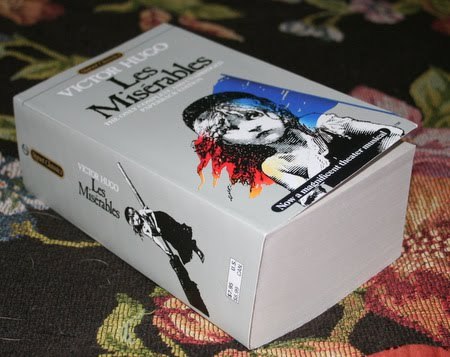
Did you know that babies from affluent families hear an average of thirty MILLION more words before age 5 than babies in families below the poverty line? For context, Les Miserables is about 650,000 words and it looks like this:
So it’s like reading this book 46 times.* And that’s not the total number of spoken words, that’s the GAP between affluent and poor babies. And these are the years in which the brain undergoes the most development. It’s mind-boggling.
So what I’m saying is: keep doing the thing. Do it to all babies, all the time. Narrate your day. Ask them for opinions. (“Should we buy the large bag of potatoes or the small bag?” “Gaabooglagje.” “Yes, just as I thought.”) Point out colors and shapes and letters. Let them scribble outside the lines and treat their babble like talk. Sing them nursery rhymes and Raffi songs and songs from the radio. All of these things are going to build their brains to prepare them for kindergarten and beyond.
*Please do not read Les Mis 46 times to an infant. They don’t even care about the Parisian sewer system.
“So Bob said […]” indicates that I am directly quoting Bob.
“Then Bob was like […]” indicates that I am paraphrasing Bob.
“And Bob was all […]” indicates that I am paraphrasing Bob, and additionally I am being a dick about it.
I don’t know about you, but I think it’s fantastic that we have a specific grammatical convention for that.
What I find most frustrating is when people don’t understand this! I don’t know if it’s a generation thing, but sometimes I’ll be talking and say “So I was like “are you fucking kidding me” and the person will look at me all horrified and say “you didn’t actually say that, did you?”
I do not like Latin. I adore Latin with the passion of Catullus’ poems and the same pathetic pining.
Latin is not easy fall in love with, but when you learn to adore it, it brings you more than just one new world.
I am not an expert in Latin considering the historical side, since my teacher that taught me from sixth until tenth grade did not touch ancient history much, while my teacher in eleventh and twelfth grade was a radical catholic priest that preferred to criticise Roman authors on our curriculum for their stories about orgies, openness about sexuality and general indulgence in life (honestly, we are talking about Latin. Come on. You really shouldn’t be surprised) and hated me for being the only atheist in class. So for any information on history, I’d recommend you one of the excellent ancient history blogs on this website. Also, look up Greek history as well because as far as I know, linguistic and cultural kleptomania of all things Greek was about as hip in ancient Rome as were ideas of conquering the entire world (and the word is Greek, too).
That being said, English is also not my only language, so I had an idea about what more extended grammar was expecting me. And that was a blessing. Now, I’m not saying that English doesn’t have difficult grammar at times – I learned it as my second language, and the start is always rough. But let’s face it: English has one article (the), nouns barely change when put through different cases, the list of irregular verbs is short and even with an at times confusing syntax, tenses are built on a few existing verb forms, and your verbs only have two different suffixes to mark person and singular/plural (-s for he, she, it or none at all). English is also the mad scientist trying to attain immortality of languages because it has puzzled itself together from parts of other languages and a huge part of it (at least one leg, the jawline and probably the nose that it keeps putting into other languages’ businesses) is rooted in Latin.
Latin… has a different word ending for nouns in every different case. It has five cases compared to English’s four, and if you add in prepositions, the real fun starts. I can’t go into detail here because I’m here to convince you and not deter you from the language, but Latin means memorizing and sometimes more so than in English. Skipping the grammar or not learning all of it? Not an option. And let me tell you, I was a tutor for Latin for a little while, and nothing – no translation – will yield to you and open up under your fingers if you do not know your grammar.
But here’s the thing, my friend.
Latin is not only beautiful and brutal with its ancient works going from light-hearted shenanigans to heartbreaking love to gods so grand and wars so terrible that we still shiver before them today.
Latin feels like home.
If you can read this post, then you know English. I don’t know what other languages you speak, dear anonymous. But our world is veined with Latin. It flows in our science, in art and literature and I cannot imagine an earth where Latin has never been because history, culture, nothing would be the same. Learning Latin is coming home because it’s always been around you, waiting for your call, for you to reach out for it, back in centuries and across time.
They say Latin is dead. I say, you can’t kill something that’s immortal and has more than eighteen different words for “to kill”, but never bothered to create something that means “yes” or “no”. Latin is not one old god but many at once and nothing can kill an army of old gods.
And then, its literature and art, its entire heritage, is so varied.
Latin can be sophisticated. It can be scientific, poetic, funny, witty, short or long, and you can have it because it’s probably already in your life.
Not to mention how many other languages will whisper your name as soon as Latin walks by your side. Spanish, Italian, French, Romanian, Portuguese, and don’t get me started on all the loanwords in English, German, Dutch…
I can write about Latin for eternities, because I burn for this language more than I do for real people, but let me show you how much Latin you already know, and how lovely it is.
You know audax because you know what brave means. You know bellum because you too have waged war and been a rebel. Maybe you’re afraid of beasts, but you know that they are all only beastiae, only animals inside. You care, so the word carus comes to you as naturally as those dear to you do. You’re not always strong, but fortis waits for you in comfort and effort and fortitude, so choose what you need. With ignis, you become fire. With mors, you take death out of immortality.
In conclusion: Learn Latin and be the the warrior of art, science, literature, culture, history and languages you want to be.


 sparksoffandommagic