This is actually really good for babies’ brain development. You’re laying the groundwork for conversation, teaching them through example that people take turns talking and listening.
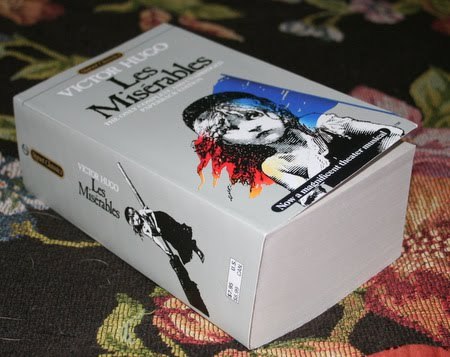
Did you know that babies from affluent families hear an average of thirty MILLION more words before age 5 than babies in families below the poverty line? For context, Les Miserables is about 650,000 words and it looks like this:
So it’s like reading this book 46 times.* And that’s not the total number of spoken words, that’s the GAP between affluent and poor babies. And these are the years in which the brain undergoes the most development. It’s mind-boggling.
So what I’m saying is: keep doing the thing. Do it to all babies, all the time. Narrate your day. Ask them for opinions. (“Should we buy the large bag of potatoes or the small bag?” “Gaabooglagje.” “Yes, just as I thought.”) Point out colors and shapes and letters. Let them scribble outside the lines and treat their babble like talk. Sing them nursery rhymes and Raffi songs and songs from the radio. All of these things are going to build their brains to prepare them for kindergarten and beyond.
*Please do not read Les Mis 46 times to an infant. They don’t even care about the Parisian sewer system.
“So Bob said […]” indicates that I am directly quoting Bob.
“Then Bob was like […]” indicates that I am paraphrasing Bob.
“And Bob was all […]” indicates that I am paraphrasing Bob, and additionally I am being a dick about it.
I don’t know about you, but I think it’s fantastic that we have a specific grammatical convention for that.
What I find most frustrating is when people don’t understand this! I don’t know if it’s a generation thing, but sometimes I’ll be talking and say “So I was like “are you fucking kidding me” and the person will look at me all horrified and say “you didn’t actually say that, did you?”
I do not like Latin. I adore Latin with the passion of Catullus’ poems and the same pathetic pining.
Latin is not easy fall in love with, but when you learn to adore it, it brings you more than just one new world.
I am not an expert in Latin considering the historical side, since my teacher that taught me from sixth until tenth grade did not touch ancient history much, while my teacher in eleventh and twelfth grade was a radical catholic priest that preferred to criticise Roman authors on our curriculum for their stories about orgies, openness about sexuality and general indulgence in life (honestly, we are talking about Latin. Come on. You really shouldn’t be surprised) and hated me for being the only atheist in class. So for any information on history, I’d recommend you one of the excellent ancient history blogs on this website. Also, look up Greek history as well because as far as I know, linguistic and cultural kleptomania of all things Greek was about as hip in ancient Rome as were ideas of conquering the entire world (and the word is Greek, too).
That being said, English is also not my only language, so I had an idea about what more extended grammar was expecting me. And that was a blessing. Now, I’m not saying that English doesn’t have difficult grammar at times – I learned it as my second language, and the start is always rough. But let’s face it: English has one article (the), nouns barely change when put through different cases, the list of irregular verbs is short and even with an at times confusing syntax, tenses are built on a few existing verb forms, and your verbs only have two different suffixes to mark person and singular/plural (-s for he, she, it or none at all). English is also the mad scientist trying to attain immortality of languages because it has puzzled itself together from parts of other languages and a huge part of it (at least one leg, the jawline and probably the nose that it keeps putting into other languages’ businesses) is rooted in Latin.
Latin… has a different word ending for nouns in every different case. It has five cases compared to English’s four, and if you add in prepositions, the real fun starts. I can’t go into detail here because I’m here to convince you and not deter you from the language, but Latin means memorizing and sometimes more so than in English. Skipping the grammar or not learning all of it? Not an option. And let me tell you, I was a tutor for Latin for a little while, and nothing – no translation – will yield to you and open up under your fingers if you do not know your grammar.
But here’s the thing, my friend.
Latin is not only beautiful and brutal with its ancient works going from light-hearted shenanigans to heartbreaking love to gods so grand and wars so terrible that we still shiver before them today.
Latin feels like home.
If you can read this post, then you know English. I don’t know what other languages you speak, dear anonymous. But our world is veined with Latin. It flows in our science, in art and literature and I cannot imagine an earth where Latin has never been because history, culture, nothing would be the same. Learning Latin is coming home because it’s always been around you, waiting for your call, for you to reach out for it, back in centuries and across time.
They say Latin is dead. I say, you can’t kill something that’s immortal and has more than eighteen different words for “to kill”, but never bothered to create something that means “yes” or “no”. Latin is not one old god but many at once and nothing can kill an army of old gods.
And then, its literature and art, its entire heritage, is so varied.
Latin can be sophisticated. It can be scientific, poetic, funny, witty, short or long, and you can have it because it’s probably already in your life.
Not to mention how many other languages will whisper your name as soon as Latin walks by your side. Spanish, Italian, French, Romanian, Portuguese, and don’t get me started on all the loanwords in English, German, Dutch…
I can write about Latin for eternities, because I burn for this language more than I do for real people, but let me show you how much Latin you already know, and how lovely it is.
You know audax because you know what brave means. You know bellum because you too have waged war and been a rebel. Maybe you’re afraid of beasts, but you know that they are all only beastiae, only animals inside. You care, so the word carus comes to you as naturally as those dear to you do. You’re not always strong, but fortis waits for you in comfort and effort and fortitude, so choose what you need. With ignis, you become fire. With mors, you take death out of immortality.
In conclusion: Learn Latin and be the the warrior of art, science, literature, culture, history and languages you want to be.
forget wanderlust, sonder, all those words for vague dreamy feelings… what I’m asking for is a concise word for the feeling you get when someone makes an assumption about you that’s 100% correct but you really don’t like that anyone was able to make that assumption. for now I’m calling it a fuckor
“he asked me ‘you main junkrat right’ and a wave of fuckor wracked my feeble body”
You know what I think is really cool about language (English in this case)? It’s the way you can express “I don’t know” without opening your mouth. All you have to do is hum a low note, a high note, then another lower note. The same goes for yes and no. Does anyone know what this is called?
These are called vocables, a form of non-lexical utterance – that is, wordlike sounds that aren’t strictly words, have flexible meaning depending on context, and reflect the speakers emotional reaction to the context rather than stating something specific. They also include uh-oh! (that’s not good!), uh-huh and mm-hmm (yes), uhn-uhn (no), huh? (what?), huh… (oh, I see…), hmmn… (I wonder… / maybe…), awww! (that’s cute!), aww… (darn it…), um? (excuse me; that doesn’t seem right?), ugh and guh (expressions of alarm, disgust, or sympathy toward somebody else’s displeasure or distress), etc.
Every natural human language has at least a few vocables in it, and filler words like “um” and “erm” are also part of this overall class of utterances. Technically “vocable” itself refers to a wider category of utterances, but these types of sounds are the ones most frequently being referred to, when the word is used.
Reblog if u just hummed all of these out loud as you read them
This still doesn’t tell me how to convey this sound in writing. I notice, in fact, that even with all those other sounds written out (hmmm, awww, etc), the I don’t know sound is not written out there!
There must be a slightly more eloquent solution than “he shrugged and made an ‘I don’t know’ sound.”
@porcupine-girl well in a text, i write it iono, but when describing it, that is definitely tougher. i sorta make the sound more like mm-NM-Mm, but that looks like it sounds different than how i hear it. this is a very confusing question.
So I used to have a Russian friend who had a pretty thick accent and like a lot of Russians tended to eschew articles. She would say things like “Get in car.” And stuff.
Well one day this asshole who had been kind of tagging along with us asks her why she talks like that because it makes her sound dumb and I still remember her response word for word.
“Me? Dumb? Maybe in America you have to say get in THE car because you are so stupid that people might just get in random car, but in Russia we don’t need to say that. We just fucking know because we are not stupid.”
Thus is why I assume the Heavy speaks the way he does. He’s not stupid.


 sparksoffandommagic