The answer is apparently “because we’re actually able to eat it”
Fun fact: white people (specifically Northern European white people) have a genetic mutation that allows them to digest lactose even after weaning, which is abnormal for all mammals and also most humans. It’s theorized that because Northern Europe doesn’t get a lot of sun, an alternative source of vitamin D (like milk) would be a useful trait. It’s a very recent mutation that would only have happened after humans started domesticating animals like cows and goats.
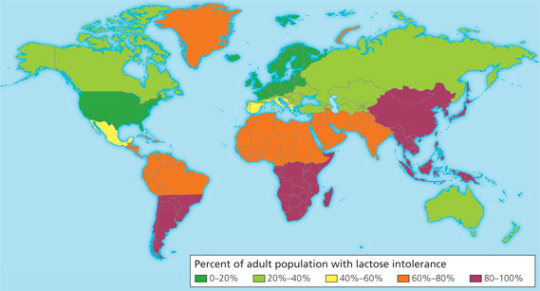
oh no, my bizarre moment has come, cause lactose tolerance is actually A Thing I Know About because it’s played a fascinating role in human evolution for thousands of years. This chart displays some of the broad trends, but it’s giving near continental averages, which doesn’t showcase how this kind of thing really breaks down and some of the surprising exceptions.
Lactose tolerance is the majority trait for only a very few population groups: North Europeans (and therefore populations that draw heavily from that stock, such as America,) nomadic central Eurasians, and sub-Saharan pastoralist Africans, but that latter group is often overlooked. The vast majority of Africans cannot process lactose, but certain people groups whose lifestyles have revolved around cattle for thousands of years will have 80% and even approaching 100% lactose tolerance rates. They’d be spots of dark green amidst a sea of orange and burgundy on the above chart.
Our hunter-gatherer ancestors were almost entirely lactose intolerant, that is definitely the biological norm (and people groups who maintained that lifestyle, such as Native Americans, remained as such – along with groups who transitioned to sedentary agricultural lifestyles, but I’ll get into that). As such, lactose tolerance is an adaptive trait that only became prevalent in environments that exerted strong selective pressure for it. So, cows were domesticated some 10,000 odd years ago in the Middle East (and some have contended for an independent domestication event in Africa as well). In either case, cattle quickly spread across the continent and we know there was milking and cheese production at least 6,000 years ago in both the Nile and Mesopotamia. While cow meat would have been enjoyed by all, in agricultural societies milk and cheese would have been options, but hardly staples as there were plenty of other things to eat as well, and therefore there would have been no selective pressure for processing lactose. Also, sedentary societies had ways of processing milk and cheese that allowed lactose intolerant people to drink/eat dairy products. Fermenting milk or aging cheese breaks down lactose, making it a non issue once ingested. This is why fermented milk may seem utterly foul to many Westerners, but is extremely common in other parts of the world. But, fermentation and aging requires time, and the ability to store things in a single location for weeks or even months. Sedentary societies adapted the milk to fit their biology, but nomadic societies did the reverse.
There are still mobile pastoralist societies in Africa today, and there have been for thousands and thousands of years. For many of them, cows are not one of many dietary options, they are the single dietary staple around which their lifestyle revolves. Biologically, this means you gotta get with the program if you wanna survive. For most mobile tribes, fermentation and aging weren’t options, so there would have been strong selective pressure favoring those who could drink milk straight outta the cow, as they would have had an additional, highly nutritious food source available to them. Milk also allowed for a marked shortening of the weaning process, transitioning children from breastmilk to cow’s milk, which would again be advantageous for groups where both the men and women work and are always on the move. Over generations these populations specialized into essentially cow-based lifestyles, creating a survival niche highly advantageous to them, and fast forward thousands of years and there are groups in Africa with near ubiquitous lactose tolerance, while the rest of the continent (and the world really) is nearly entirely intolerant.
Many of these same factors would have influenced the central Eurasian populations, which is why Mongolians and other descendants of nomadic steppe peoples are largely lactose tolerant, as mare’s milk would have been a dietary staple (though they also developed efficient ways to ferment it).
North Europeans developed lactose tolerance in response to deficiencies in certain nutrients. The northern climate limited Vitamin D production, and the agricultural products available to them were often low on calcium and protein, and so dairy farming developed alongside agriculture to create a more rounded diet (and this was limited to Northern Europeans, as Mediterranean peoples such as the Romans wrote about their great confusion at the northern barbarians’ ability to drink fresh milk)
And I promise all of this is fascinating because the ability to process lactose evolved independently in several different population groups and in response to different factors: lifestyles revolving around cows, lifestyles revolving around horses, deficiencies in climate and agriculture. Besides providing insight into human history and biology, lactose tolerance is also a great example of convergent evolution, where different genetic populations in different environments produce similar results.
And uh, that’s my rant about the role of milk and lactose tolerance in human evolution.
My fav part is “I promise all of this is fascinating”.
they told us about this in my intro biology course? like apparently being a Sphere maximizes your surface area to volume ratio, which leads to losing less heat.
so the colder the climate, the more Sphere animals become.
I love them so much because they’re about as sharp as a baseball and their anatomy is ridiculous to the point of them literally being classified as plankton for years because they just sort of get blown around by the ocean and look confused, but because they lay more eggs than ANY OTHER VERTEBRATE IN EXISTENCE, evolution can’t stop them
Why is no big predator coming and gnawing on them?
Their biggest defense is that they’re massive and have super tough skin, but they do get hunted by sharks or sea lions sometimes and they just sort of float there like ‘oh bother’ as it happens
Even funnier, because they eat nothing but jellyfish they’re really low in nutritional value anyway, so they basically survive by being not worth eating because they’re like a big floating rice cracker wrapped in leather.
Perfect example of “survival of the fittest” NOT meaning being some hyper aggressive, muscular manly asshole. This creature fell upon the complete opposite combination of traits and just rolled with it and evolution was like “well, it’s working, somehow".
The Titanoboa, is a 48ft long snake dating from around 60-58million years ago. It had a rib cage 2ft wide, allowing it to eat whole crocodiles, and surrounding the ribcage were muscles so powerful that it could crush a rhino. Titanoboa was so big it couldn’t even spend long amounts of time on land, because the force of gravity acting on it would cause it to suffocate under its own weight.
I’m so glad they aren’t around
omg me too. I’m scared enough of 26 ft long anacondas. I’m so happy Megalodons, those giant sharks, aren’t alive either
Praise natural selection
I remember watching Walking with Beasts or something similar, or some British tv show about evolution
The subject was something like a 12 foot long water scorpion
I was so startled by its sudden appearance and narration that I yelped: “12 fucking feet?!?! I’m fucking glad it’s extinct!”
Dude, prehistory was home to some fucking TERRIFYING creatures. For some reason, everything back then was enormous and scary. Extinction doesn’t always have to be a bad thing!
And Poppy, what you saw was an arthropod known as Pterygotus (it was actually featured in Walking With Monsters). Not only was it as big (or maybe even bigger) than your average human, it had a stinger the size of a lightbulb. REALLY glad that bugger isn’t around anymore.
Also, Megalodon deserves to be mention again, because just hearing its name makes me want to never be submerged in water ever again.
GOD, I HATE THIS POST. HOW DO WE EVEN KNOW THAT SHIT ISN’T STILL AROUND? LURKING? EVOLVING? WE DON’T. WE DON’T KNOW SHIT ABOUT SHIT DOWN THERE. THE OCEAN IS A PRIMEVAL HELLSCAPE NIGHTMARE AND WE ALL JUST DIP OUR STUPID FRAGILE UNPROTECTED FETUS BODIES AROUND THE EDGES OF IT LIKE THAT’S NORMAL. FUCK THE OCEAN.
this is so relevant to my interests
It wasn’t just the predators. North Carolina was once home to giant ground sloths…
THAT IS A GODDAMNED LEAF-EATING SLOTH.
We’ve got a skeleton of one of these fuckers at the museum downtown, and man, just being NEAR it is unsettling.
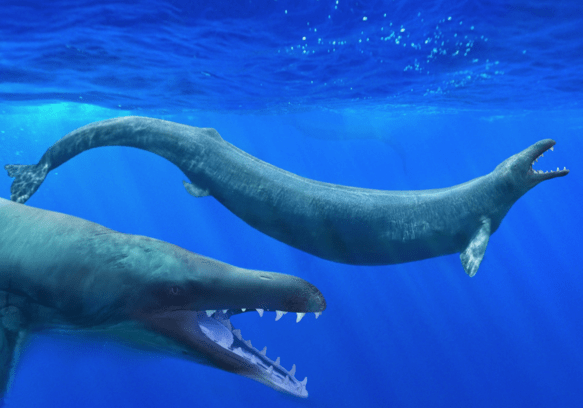
DON’T FORGET PREHISTORIC WHALES, SOME OF THOSE FUCKERS WERE TERRIFYING
AMBULOCETUS WAS AMPHIBIOUS AND PRETTY BADASS
BASILOSAURUS WAS THIS GIANT REPTILIAN CETACEAN THAT PROBABLY SWAM LIKE A DUMB EEL BECAUSE OF ITS TINY FLUKES BUT THIS FUCKER WAS 60 FEET LONG AND AT THE TOP OF THE MARINE FOOD CHAIN
AND THEN THERE’S MY FAVORITE, ZYGOPHYSETER, WHICH WAS THIS HUGE EARLY SPERM WHALE THAT ATE SHARKS AND OTHER WHALES
IT WAS NOTHING BUT TEETH
The reason why the animals in the prehistoric times were so big was because there was much more oxygen in the atmosphere if I recall correctly. Because there was so much oxygen and so few carbon gasses, life on earth was able to grow to terrifying lengths and heights, don’t forget how giant the bugs were.
I have never seen so much prime nope in a single post
Also important to note that megalodon is theorized to still be alive,possibly living in the darkest depths of the ocean. They haven’t found signs of its extinction
scientists: “we haven’t seen a megalodon in quite some time now, let’s just hope it’s exstinct”




 sparksoffandommagic