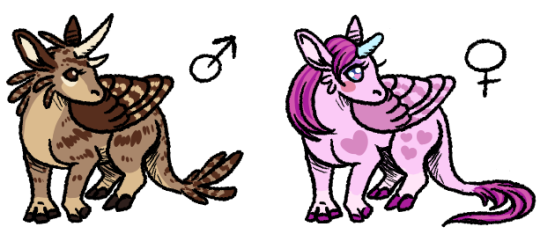
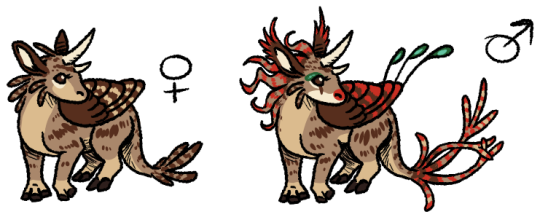
I’m banning content creators from having sexual dimorphism in their fictional species until they stop being cowardly and commit to having the females be drably colored and a little bit fatter, while having the males look like they came out of Cirque du Soleil while screaming the fantasy beast equivalent to Led Zeppelin’s “Whole Lotta Love”
I’m reading this queer anthology and the first story is a fairytale about a queer Latina girl whose anger was so fierce it literally poisoned the rich white men who unfairly captured the transgender soldier she was in love with and my heart is literally bursting I’m going to cry
the second story is about two queer girls who leave their husbands-to-be at the altar and flee together on a boat to become pirates IM FUCKING SCREAMING THIS IS EXACTLY THE KIND OF GAY CONTENT I SIGNED UP FOR
okay this is the anthology and it’s entirely written by queer authors and inspired by the stories of real queer teens in history and it’s the most wholesome and epic thing I’ve read in a long while
oh fucking boy are you into a treat bc u bet ur ass i know the answer to this and its not pretty like tw: the answer to carnivorous plants eating human flesh
okay, so in the carnivorous plant community there’s this botanist named barry rice. rice is a pretty significant figure, and has written some books, is the editor of the ICPS’ quarterly newsletter, has contributed to a considerable amount of research, and is overall a pretty respectable dude who still studies carnivorous plants and does lectures and stuff. he also runs a website called sarracenia.com, where he answers a lot of carnivorous plant questions ranging from simple care ones to advanced info.
back in 2005, Rice got athlete’s foot. he got like. really, really bad athlete’s foot, and when he finally got meds to get it under control, some dead skin had started peeling off. like, sizable chunks of flesh. so he did the reasonable thing and decided to test this to see if his venus fly traps would eat them.
now, venus fly traps can’t eat anything that doesn’t move- the stimulation of the struggling organism retriggers the hairs inside the traps to confirm to the plant that it’s snapped onto something, and the more movement it makes, the harder the plant seals the vacuum and the more digestive fluids are released. such is life. so Rice added small earwigs to 2 of the 4 samples (samples 2 and 3) to simulate movement (but all 4 ended up eating the samples regardless). being a scientist, he also scanned in the chunks pre-being eaten, and fed the chunks to not just one venus fly trap, but to a normal venus flytrap plus three other different varieties. he then waited. he assumed that the plants wouldn’t be able to eat the skin, as he assumed that it would be too hard for them to eat (skin callouses + his resident fungal ordeal).
when the traps finished digesting and opened a few weeks later, rice collected the carnage, scanned them in, and posted about his experiment on his website. what he found was that not only did the plants eat almost all of his toe chunks (i would estimate about 95% based on the images), but they also rejected some parts, which they had sucked all digestible nutrients out of. we see this kind of skeletonization in small animals that fall into carnivorous nepenthes pitchers, but it takes several months of them sitting in there to become fully digested, and in rice’s case, there wasn’t even any bones involved and it took comparatively significantly less time to do so. he then compared all four of them to their pre-digestion counterparts.
this is pretty interesting, because from what I can tell with my limited knowledge of human biology, it looks like the plants chose to eat away almost all the cartilage?? rice couldn’t seem to make any sense of the color change; to me it seems like they almost rejected any and all blood present in the skin capillaries (how much blood is in any part of ur body at once?? isn’t that like, a thing, where like there’s a small amount of blood touching all ur cells always?? did the plant just condense all of the trace amounts in those chunks and reject it??) but to me, that doesn’t make much sense; isn’t blood a pretty easily easily digested thing? like if you’re not an animal, you would think that that would be a pretty sweet and easy source of protein and stuff. Why would they reject that??
my other hypothesis on looking at that is that it rejected the super diseased portions. or maybe the toughest parts. maybe if it hadn’t finished its natural time-mediated cycle of digestion so soon, it would have finished digesting what was left over. maybe it had undesirable nutrients, or whatever reacted with the weak acid in the plants to produce a chemically indigestible product. idk, this is honestly an experiment i’d like to see replicated on a professional level, preferably with a pre and post examination of the chemical composition of the flesh, you know? and this doesnt even get into the differences in how the different varieties of venus fly trap ate the chunks; the first cultivar, a garden variety wild type, seemed to make the most dent in it, but also didn’t have a bug added. that being said, sample 4 also didn’t have a bug added, and had a similar digestion level to plants 2 and 3; this confirms for us that what was left over by the plants was, indeed, undigested toe chunk specifically. so why did the first variety eat the most? did it have a longer digestion period, or a stronger acid (being an unbred variety), or maybe it’s toe chunk had less of- uh, whatever the plants didn’t like?
i wish barry had included a chart of other aspects of the plants, like their age and the size/number of the traps and stuff, and information on the cultivars, the last time they had been fed, maybe an analysis of the digestive fluid of each, etc. basically a scientific paper. yeah, i wish rice had made this into a proper scientific paper.
so anyway. I’m not sure what would happen with sundews, as those are a distinctly different plant, but a similar mechanism would be needed; you would need to wiggle your finger occasionally to keep the plant convinced that it hadn’t made a mistake. it would probably take weeks, or months, but eventually it would either 1. eat what it could wrap itself around to the bone or 2. make at least a dent in the digestible meat of your finger. eventually it would stop eating and unravel, wether it was digested or not, because these are active traps we’re dealing with. maybe it would spit out/eat around parts that it didn’t like in the process. idk man if i ever actually come across the means to test this i promise i will report here on this blog first
this is actually 100% easy for me to believe bc 1. only a man who dressed like this would possibly feed infected foot chunks to his plants and 2. i also want to point out that before toe foot chunk man barry rice was a botanist he was an astronomer and got his undergrad degree in physics and did his master’s studying the NGC 2264 nebula and then fell in love with plants and made groundbreaking strides in growing and keeping carnivorous plants and now teaches astronomy at a university while doing wild plant stuff on the side….its never too late to fall in love with plants lads





 sparksoffandommagic